
BOP2 Infographics Assignment
The stories of travelling the world for sailing, while knot quite being in the A Team
Before any race in sailing begins there is always a five minute start sequence which allows people to get themselves ready and on the line before go.
Unlike in running, we can’t just walk up to the line and start moving when the gun goes. It is almost impossible to have a boat completely stationary in the water without an anchor, something my boat doesn’t have.
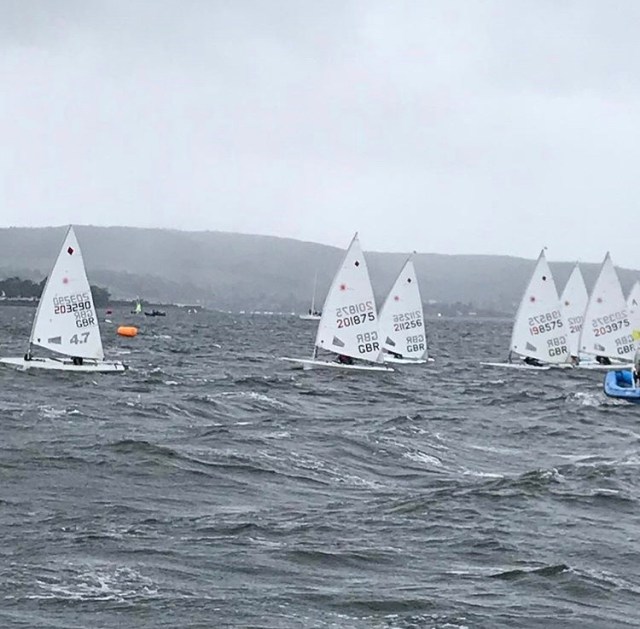
5 minutes, 4 minutes, 1 minute and go are all accompanied by a flag and sound signal to warn sailors how long they have before the race.
In that sequence, we sometimes have the excitement of seeing the black flag being used.
And by sometimes I mean
All
The
Time
Because my class is really bad at starting properly.
The rules of starting are easy enough. When the gun goes, cross the line. The problem is that in order to cross the line, you have to have been behind it in the first place. Should be simple and yet, in a vessel that never fully stops, it is easy to find yourself pushed over.
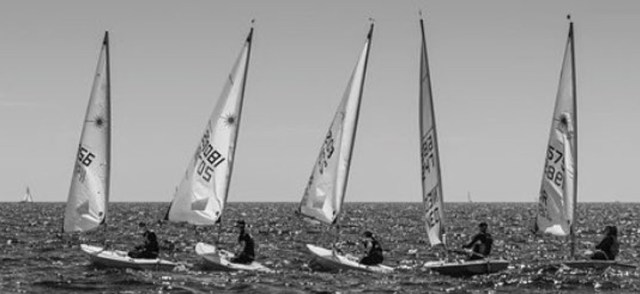
If the race committee thinks that too many people were over the line for it to be a fair start, they will pull the fleet back and make them do the start sequence again. Only this time they replace the U-Flag with the Black-flag.
The black flags means that if you’re over the line at the beginning of the race you will be disqualified until after that race is sailed.
If the race is sailed immediately then it’s fine because you can race in the one straight after that. If the race is delayed though, you might have to wait as long as over-night before you’re allowed to race again.
The only two times I’ve been black flagged in 7 years of racing, I’ve had to do that.
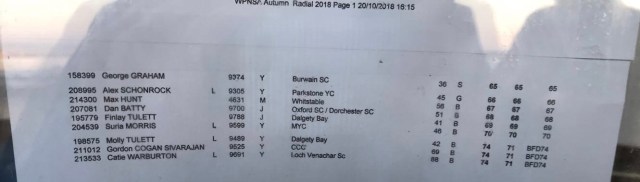
You’d think the prospect of a black flag would make people think twice about being too close to the line but you’d be amazed. If it’s the last race of the event, most people will actively try to get a black-flag disqualification because then they can go in early to pack up and head home.
On cold days, the fleet can have up to half the boats disqualified like this before we’re able to get a race done.
Our coaches also get particularly irritated when we lose out on sailing time as a result of pushing our own team mates into black flag territory…
A key part to understanding my sport is knowing what the flags mean.
There are a few flags which I come across more than often, and each of them apply to a different part of the day. Most flags correspond to a letter and that can make them easier to remember.
The first one I usually see is my class-flag. I sail in the Laser Radial class and so we have a green flag with the laser symbol over the top.
Underneath is the launch flag. Now you’d think that one would be easy, L for launch right? Nope. For some reason this one is the blue and yellow striped D-flag.
Once we’re actually out at the race area, there’s usually the well-known AP flag to signal a postponement in the beginning of racing while the committee set the course.
The white and red stripes can be seen for miles and it’s usually greeted with complaints from those who just want to get the day started.
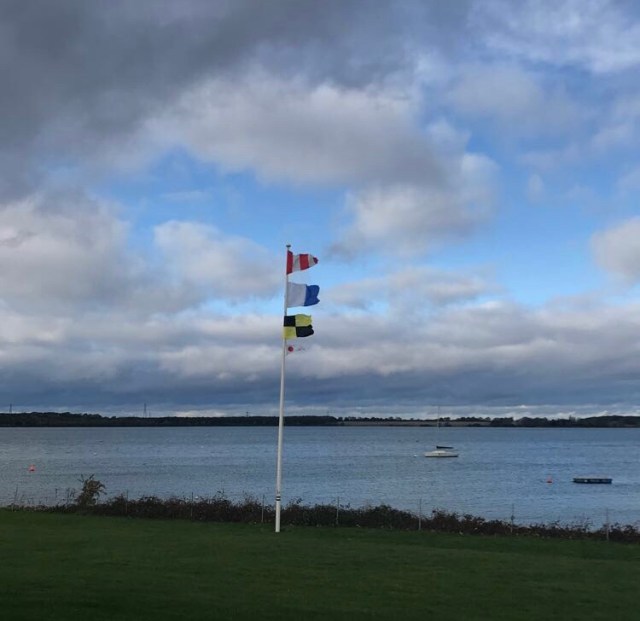
The start sequence flags are the most important. At five minutes to the start, the class flag goes up with a sound signal. A minute later, it’s joined by the U-Flag which looks exactly like the English flag, to warn us that there’s four minutes to go.
At four minutes to go though we sometimes get a Black-flag instead, but that’s a story for another time.
There’s a brief silence until it’s taken down with a whistle at one minute to go, with the class flag joining it at the start of the race.
After that, it’s rare to see anymore flags. Sometimes if it’s a strange weather kind of day, we’ll see a C-flag displayed on a ‘Charlie board’ to show us that the course markers have been moved in the middle of a race.
If the wind dies mid-race, we can be lucky enough to see the blue and white S-flag signalling a shortened course.
If you’re very unlucky and you take too long to finish a race, you might be shown the W (whiskey) flag and asked to return to the start area without completing your race.
The final flag you might have the misfortune to see is the yellow flag as it’s waved at you from a jury boat, signalling that you have to take a 720° penalty turn.
In sailing we have a number of rules which are designed to make races (and general sailing) safer and easier to manage. Our sport is what we call “self-governed” which means that if we break one of those rules, we are supposed to carry out the penalty on our own, without it being enforced by a jury.
The most common penalty we have to take is a penalty turn. The number you’re expected to take varies depending on which rule you infringed upon.
If you hit one of the course marks, you have to do a 360° turn (one tack, one gybe). If it’s another competitor you hit, it’s a 720° (two tacks, two gybes).
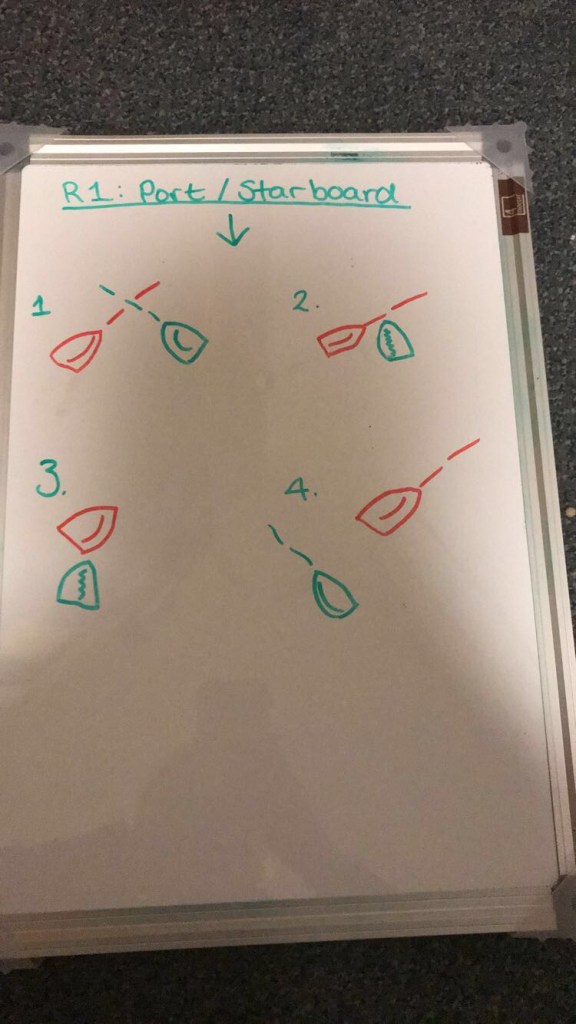
In some cases though, it is not always as easy to tell when to take a penalty turn. For example, if a competitor is jabbing their rudder from side to side in order to move turn their boat faster, this technically breaks Rule 42 which bans all illegal propulsion.
If a sailor does not take their penalty turn, a jury boat will usually come and tell them to. We call this yellow flagging because the jury comes over, waves their wee flag at whistles at you to do a 720.
I’ve only ever been yellow flagged once, and to be honest I’m still annoyed about it.
What had happened was another competitor had come to close to me at a mark and knocked into me. I called protest on them but it was too late and they pushed my boat into someone else and then also into one of the course markers.
As a result, I had to do not just a 360 but also a 720 on top of it. It was a super light-wind day and so three turns was going to cause me to slip right down in the rankings.
I got pretty annoyed and slammed the rudder round to get through my turns as quickly as possible because like I say, it’s a self-governing sport and no matter how mad you get, you still have to take the penalty where it’s due.
Unbeknownst to me however, the Jury was sitting right behind me in a rib as I jabbed the steering over and over.
As soon as I finished my three turns I started to head on my way, but was only sailing for about 3 seconds before I heard the whistle and turned around to see that yellow flag flapping around in my direction.
Consequently I ended up doing a total of 5 turns which landed me nicely at the very back of the fleet.
If you don’t take the time to do a penalty on the water though, you end up having to explain the situation in a protest hearing which (trust me) is far worse than just doing it during the race.
Whenever anyone finds out that I’m a sailor, their first questions are almost always “have you ever capsized?” and “isn’t it cold in winter?”
The answer to both is, yes, I have capsized a lot. And yes, it is very, very cold.
Very cold.
Capsizes happen much more easily than you might think, resulting in extended time untangling ropes and emptying water out of the cockpit.
The important thing to remember is that in the size of boat I sail, you’re unlikely to get injured in a capsize, mostly all that’ll happen it you’ll get wet.
I used to sail a skiff and the first thing our coach told my partner and I was that it takes 100 capsizes to learn to sail a 29er. We only sailed together for about 6 months but I really think we came close to that target.
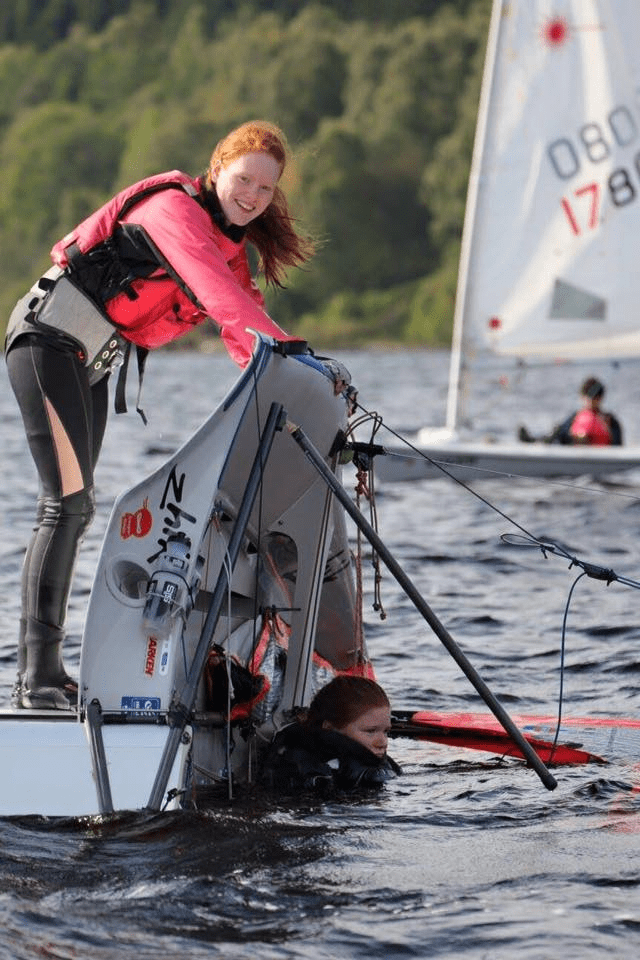
If you let go of a skiff in the water while you’re launching, it will just fall over. They really are not designed to stay upright although that doesn’t stop you feeling a little demoralised after your fifth capsize of the hour.
The boat I sail now is much more stable and can stay upright on its own. I have definitely had my fair share of swimming with it too though.
In one of my first weekends sailing Lasers, I managed to execute a perfect Eskimo roll of my boat. This is when you end up being pulled underneath your boat as it capsizes and then pushed back out the other side by the water. Always a fun one.
Some of my favourite capsizes though are the light wind ones. There’s really no excuse to be falling in in no wind and yet I seem to do it all the time, much to the disappointment of many coaches.
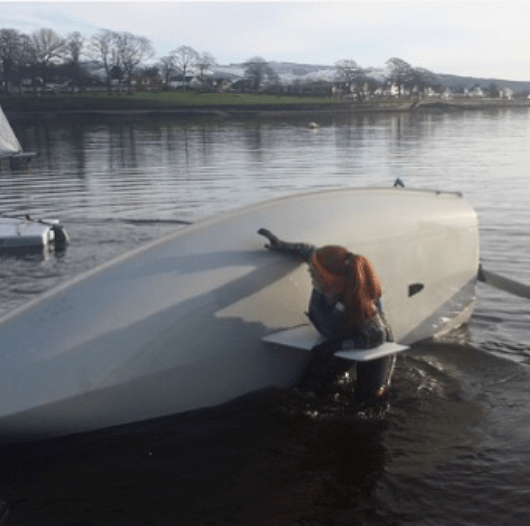
Perhaps my finest capsize of all though will be a real gem from Loch Venechar winter training this year when an unexpected wind drop and shift resulted in a lovely backwards roll into the water for me.
I’m hungry all the time. It’s a well-known fact about me.
It means being prepared before an event is critical to make sure I can make the proper decisions to get me to the finish in a good position.
Preparation and recovery, especially at a week-long event is especially important, since the longer the event, the longer you have to maintain your fitness for.
For me, the most common week-long event I do is the UK national championships.
During racing, all the food gets kept on a coach boat so we have to take it out in a dry bag. Sometimes we team up, so one of us takes it out in a big bag to the coach.

A typical morning there would be to start the day with a pot of porridge with a banana, while getting chicken rolls and pasta ready for on the water.
Once I arrive at the club, I eat half of the pasta and drink a bottle of water while I rig. Especially in summer, drinking enough is one of the most important things to remember because being dehydrated can be risky out on the water.

After launch it’s time for one of the rolls, a cereal bar and half a bottle of water with a Science in Sport tablet mixed in. SIS makes you feel like you’ve just downed 14 shots of espresso and really helps power you through the racing.
After race 1, I’m back for another cereal bar, a roll, the other half of the pasta and the rest of the first water bottle.
By the end of race 2 just an hour later, I’m usually starving again so, while I’m on the long sail in I have one last roll, any extra cereal bars floating around in my boat and a whole bottle of water.
As soon as I’m finished de rigging for the day, I’ll go and grab some of the so-called “sailor pasta” which the hosting club usually provides for us because that helps me begin my recovery phase before the next day.
Maintaining fitness and energy throughout a week-long event is sometimes one of the hardest things to do and trust me, no one eats as much food as sailors.
Every year in sailing is different but follows much the same pattern. Winter academies, springs, March qualifiers, travellers, summer racing, October qualifiers, winter championships, academies. Rinse and repeat.
I wouldn’t want it any other way but this year, in amongst the normal events, I got to do something a little different.
My 2019 season was relatively more quiet than usual. I was trying to finish off my last year at school and get the grades I needed to go to university so I focussed more on events early in the year and usually only the ones that were at weekends.
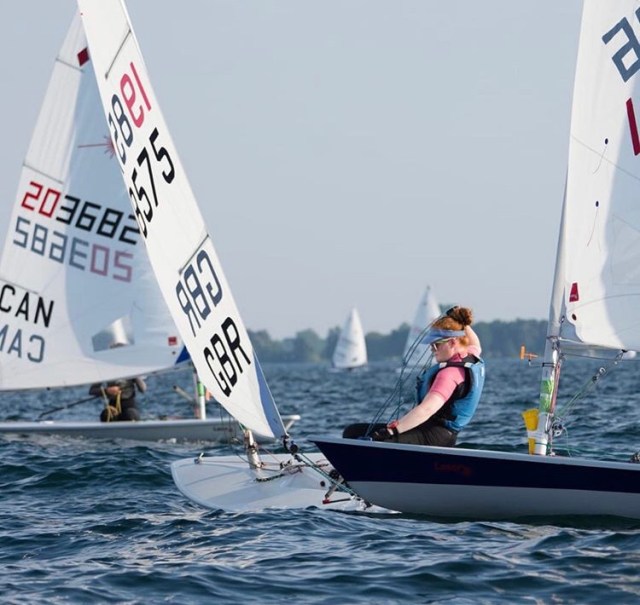
It was also quieter because in the summer, instead of my usual two or sometimes three weeks of sailing, I skipped the UK national championships for three weeks in Canada to compete in the U19 Radial Youth World Championships instead.

Without a doubt, Canada was one of the best opportunities that sailing has been able to offer me.
My parents, my brother, one of my closest friends and I flew out to Toronto together. We spend a day there exploring the city before heading up to Kingston where the event was taking place.

There were 16 of us there who were representing Great Britain. For the week before the event started we took some time getting our boats sorted out after their long journey to Canada and getting used to the venue in a training situation.
The event itself was six days of perfect weather conditions, beautiful sunshine and decent wind which allowed us to get two races in every day with no hassle.
It was one of the best events I have ever competed in and hands down the best event of 2019. I can only hope that something even close to it might come up in 2020.
The RYA Scotland Winter Class Academies always mark the end of the autumn qualifier season.
They’re usually held across six weekends between November and March to help us hone some of our basic skills and are a chance to work on things we’ve been struggling with since last winter.
We like to switch up the venues of these events so as we are able to sail in a variety of different conditions as everywhere has different skills required.
This year for the first time we went to St Andrews and it was quite an experience.
The river near the boat park was deceptively calm and I started the day off optimistically, looking forward to a few strong hours on the sea.
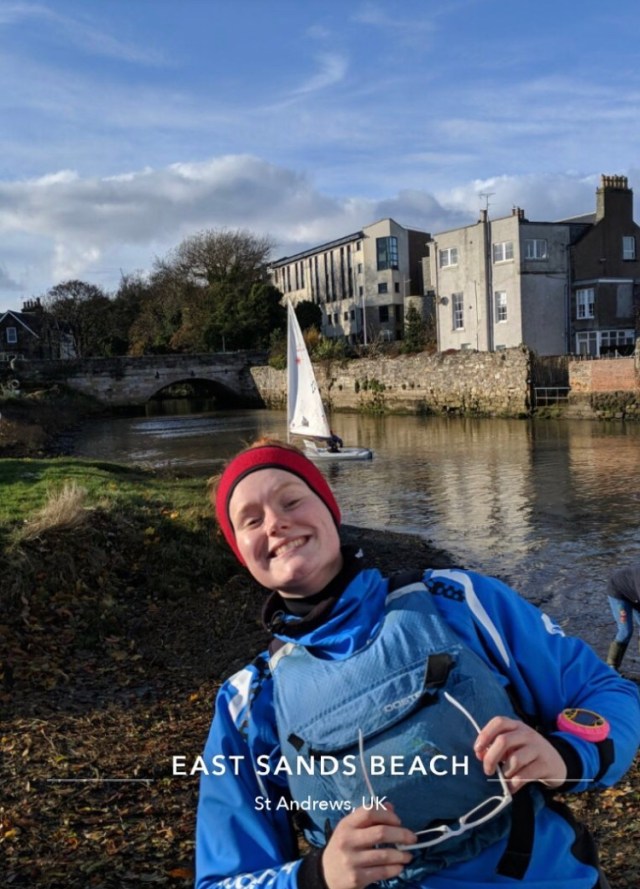
However, despite there being not much wind the waves were almost above head height at the launch area.
With a number of inexperienced sailors at the event, the more able of us were asked to help get them off the beach.
The average launch time for the 15 or so boats present would be around 10 minutes at the slowest. Instead it took us over an hour to get everyone out with most boats taking a minimum of three sailors to launch. By the time we finally made it out, I was soaked from head to toe and freezing in the tropical -2° air.
From there ensued perhaps the single coldest hour on the water I have ever had the misfortune to experience. On the up side however, our coaches decided it was safer to take us back in past the harbour so we got to show off to some of the local fishermen as we manoeuvred our boats back under the bridge and safely to shore.
After that weekend I don’t think I have ever been so grateful to make it back to Caledonian Court, its central heating is just so much more effective than a wetsuit.
It took me about a week to get warm again and I spent most of that time considering taking up an indoor sport. Perhaps table tennis?
In my opinion you can never have too much tinsel at Christmas.
That idea was reinforced in my mind by the competitors at this year’s RYA Winter Championships in Largs who went all out decorating their boats for the last event of 2019.
It’s become tradition at the Winters that whoever has the best decorated rig wins an extra prize at the end of the event and it’s become more competitive than the actual racing.
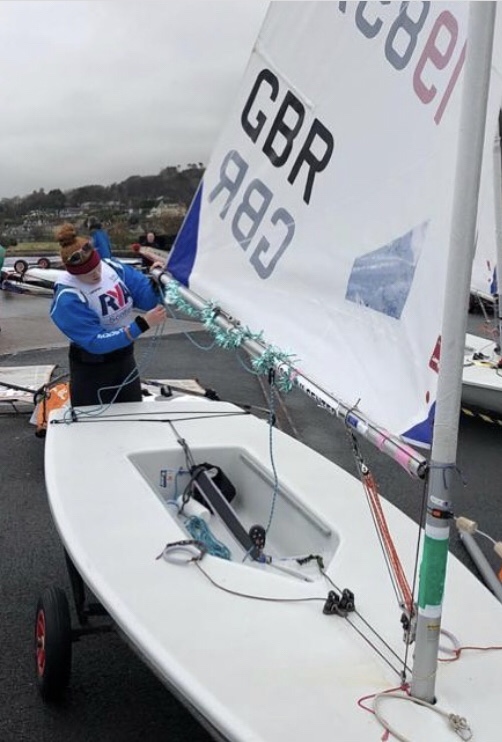
Before launch, all 63 crews spent an hour wrestling with lights and dressing both themselves and their boats up.
I opted for the classic of wrapping tinsel around the bottom of the sail with fairy lights duct taped alongside it.
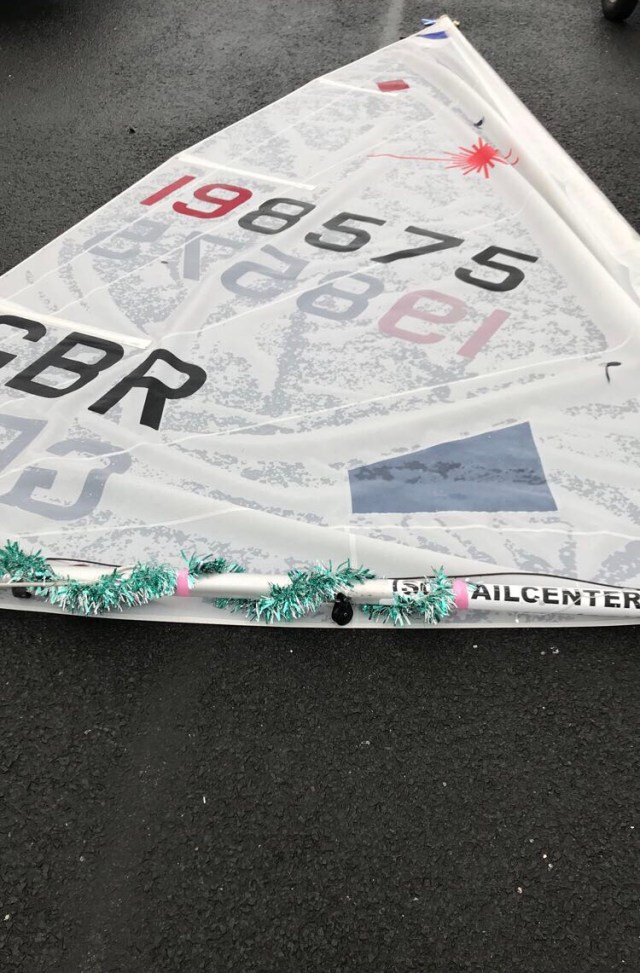
I’ll admit that mine definitely wasn’t the best but I like to think that’s because my boat isn’t as big as some of the others there and so I didn’t have the same room for creativity.
It also looked much better when it wasn’t partially submerged in the ever freezing Largs channel.
The Winters is typically one of our windiest events and this year was no exception, but nothing cheers up your fifth capsize of the day quite like some strangely resilient fairy lights.
Even with the windy weather and the driving hailstones, the Winters is always my favourite event of the year. It’s far more informal than other events in the year so we’re able to play around with different race shapes.
This year’s race committee decided to put is on a sausage course, which was an interesting choice but certainly narrowed down the number of potentially dangerous manoeuvres we had to do in the stormy conditions.
After three races I finished overall in 2nd girl position and 6th overall which I entirely put down to the encouragement provided by the tinsel, even if it was a bit tricky to get on.
Twitter: https://twitter.com/MollySailing
 Team GBRn't